You’ve got a crack in your stucco. Maybe a hole from where something hit the wall. Or maybe you’re just noticing patches from a previous repair that never quite matched, and now they’re more obvious than the original damage.
Here’s the thing: patching stucco isn’t just about filling the gap. It’s about matching texture, understanding your material, and knowing whether a patch will actually hold in Florida’s climate. Because what works in Arizona doesn’t always work in Orlando, where humidity and rain put different pressure on your exterior.
This guide breaks down what you need to know about matching stucco texture, when patching makes sense, and how stucco compares to other exterior options if you’re weighing a bigger change.
Professional Stucco Patching Techniques for Different Damage Types
Not all stucco damage needs the same approach. A hairline crack needs different treatment than a fist-sized hole, and understanding the difference saves you time and prevents bigger problems down the road.
Hairline cracks under 1/16-inch are usually surface-level. They happen from normal settling, temperature changes, or just age. These can often be patched with a quality acrylic caulk or elastomeric sealant. The key is cleaning out any loose material first and making sure the crack is dry before you seal it.
Larger cracks or holes require actual stucco patching compound. You’re not just sealing—you’re rebuilding layers. That means removing loose material, sometimes adding mesh for reinforcement, and applying stucco in stages so each layer can cure properly.
How to Match Existing Stucco Texture and Color
This is where most DIY repairs fall apart. You patch the hole, but the repair looks like a Band-Aid on your wall. Matching stucco texture isn’t guesswork—it’s about understanding what you’re working with.
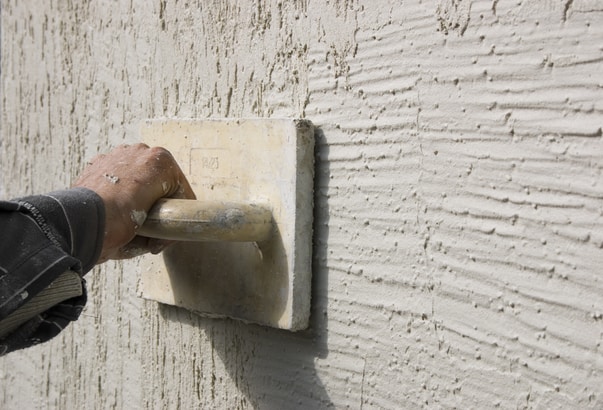
Start by figuring out what kind of finish you have. Is it smooth? Sand finish? Dash? Cat face? Each one requires different tools and techniques. A smooth finish needs a steel trowel and a steady hand. Sand finishes use a sponge float to bring the aggregate to the surface. Dash finishes might need a hopper gun or flicking technique.
Here’s what most people don’t realize: color is only half the battle. The way light hits the texture matters just as much. If your sand size is wrong or your trowel technique is different, the patch will show even if the color matches perfectly. That’s because texture affects how light reflects off the surface.
Wet stucco looks completely different than dry stucco—usually 3 to 4 shades darker. Don’t judge your color match while the patch is still wet. Give it at least 24 to 48 hours to cure and show its true color. If you’re mixing your own color, test it on a hidden spot first and let it dry completely before committing to the visible repair.
The aggregate size matters too. If your existing wall uses coarse 16/20 mesh sand but you patch with fine 20/30 mesh, the patch will look smooth and shiny compared to the rough surrounding wall. You need to match not just the color but the actual material composition.
For texture replication, practice on a scrap board first. Try different tools—sponge floats, rubber floats, steel trowels, stiff brushes. See which one gets you closest to your existing texture. Then work on blending the edges of your patch so there’s no hard line where the repair meets the original surface.
When Patching Works and When You Need Full Replacement
The honest truth is that not every stucco problem can be patched. Sometimes what looks like a simple crack is actually telling you about a bigger issue underneath.
Patching makes sense when the damage is surface-level. Small cracks with no moisture behind them. Impact damage where the stucco broke but the substrate is fine. Isolated areas where the finish coat is failing but the base layers are solid. If your stucco is relatively new and the damage is clearly from an outside force—not from moisture or structural movement—a patch will probably hold.
But if you’re seeing signs of moisture damage, patching is just postponing the inevitable. Soft spots that feel spongy when you press on them. Dark stains around cracks. Mold or mildew growth. Bulging areas where the stucco is pulling away from the wall. These aren’t surface problems—they’re symptoms of water getting behind your stucco and doing damage you can’t see.
In Florida’s climate, moisture is the enemy. Our humidity doesn’t just sit on the surface—it finds its way into cracks and stays there. Once water gets behind your stucco, it can damage the metal lath, rot the substrate, create mold, and compromise your wall structure. At that point, patching the visible crack doesn’t fix what’s happening behind it.
Extensive cracking is another red flag. If you’re seeing spiderweb patterns, multiple cracks spreading across a wall, or cracks that keep coming back after you patch them, that usually means structural movement or a failing stucco system. You can keep patching, but the cracks will keep returning because the underlying cause hasn’t been addressed.
Age plays a role too. If your stucco is 40 or 50 years old and starting to show widespread deterioration—crumbling, chalking, losing adhesion—you’re probably looking at replacement rather than repair. At a certain point, the material has reached the end of its useful life, and trying to patch your way through it becomes more expensive than just replacing it.
The decision often comes down to this: is the damage isolated and surface-level, or is it widespread and indicating a deeper problem? We can help you make that call by doing moisture testing and inspecting what’s happening behind the surface, not just what you can see.
Cost of Stucco vs Siding: What Florida Homeowners Need to Know
If your stucco problems are adding up, you might be wondering whether it makes more sense to stick with stucco or switch to a different siding material altogether. The answer depends on your specific situation, your budget, and how long you plan to stay in your home.
Stucco repair costs vary widely. A small patch might run $8 to $20 per square foot. For a typical repair on a 1,500 square foot home, you’re looking at $400 to $1,500 depending on the extent of damage. Full stucco replacement runs $9,000 to $13,000 for an average home, or about $7 to $17 per square foot installed.
Compare that to other siding options in Florida, which range from $4 to $13 per square foot depending on the material. Vinyl is on the lower end, fiber cement in the middle to upper range, and quality stucco systems toward the higher end. But upfront cost doesn’t tell the whole story.
Fiber Cement vs Stucco for Florida’s Climate
Fiber cement has become a popular alternative to stucco, especially for homeowners who’ve dealt with moisture problems. The question is whether it actually performs better in Florida’s challenging conditions.
Fiber cement is made from cement, sand, and cellulose fibers. It’s engineered to resist moisture, won’t rot, and doesn’t crack the way traditional stucco can. In Florida’s humid climate, that moisture resistance is a real advantage. Fiber cement doesn’t absorb water the same way stucco does, which means less risk of the material breaking down or harboring mold behind your walls.
The material is also more flexible than stucco. That subtle give helps it handle building movement and temperature fluctuations without cracking. Florida homes deal with both—settling foundations, seasonal humidity changes, and temperature swings that can stress rigid materials like stucco.
Installation is generally easier with fiber cement. It comes in panels or planks that get fastened to your wall, rather than being applied wet in multiple layers like stucco. That means less room for installation errors and fewer opportunities for moisture to get trapped during the process. With stucco, if any layer doesn’t cure properly or if moisture barriers aren’t installed correctly, you can end up with problems that don’t show up until years later.
Maintenance tells another part of the story. Fiber cement typically needs repainting every 10 to 15 years, but it doesn’t require the same kind of ongoing crack monitoring and moisture management that stucco does in humid climates. Many fiber cement products come with factory finishes that resist fading and hold up well under Florida’s intense UV exposure.
The lifespan is comparable—fiber cement can last 30 to 50 years with proper maintenance, while well-maintained stucco can go 50 to 80 years. But that “well-maintained” qualifier is key. In Florida’s climate, keeping stucco in good condition requires more vigilance than in drier regions.
One advantage fiber cement has is versatility. It can actually mimic stucco’s appearance if that’s the look you want, but it can also replicate wood siding, smooth panels, or other styles. So you’re not locked into one aesthetic. Stucco gives you texture and color options, but it’s always going to look like stucco.
Cost-wise, fiber cement runs $10 to $15 per square foot installed, which puts it in the same range or slightly higher than quality stucco work. The difference often comes down to long-term costs. If you’re in an area prone to moisture issues, fiber cement’s resistance to water damage could save you money over time by avoiding the repairs that stucco might need.
Cement Siding vs Stucco: Performance and Value Comparison
When people talk about cement siding, they’re usually referring to fiber cement products, though the term can also include cement board and other cement-based siding options. Understanding how these stack up against traditional stucco helps you make a practical decision for your Florida home.
The fundamental difference is in how the material gets applied. Stucco is a wet-applied system that becomes a continuous surface once it cures. Cement siding consists of individual pieces—panels, planks, or shingles—that get fastened to your wall. That difference affects everything from installation to long-term performance.
With stucco, you’re creating a monolithic shell around your home. When it’s done right, that’s a strength—no seams for water to penetrate. But it also means any failure in the system can be harder to address. If moisture gets behind your stucco, you might need to remove large sections to find and fix the source. With cement siding panels, you can often remove and replace individual pieces without disturbing the entire wall.
Moisture management is where cement siding often has an edge in Florida. The panel system allows for drainage planes and ventilation behind the siding. Water that gets past the surface has a way to drain out rather than getting trapped. Traditional stucco systems can trap moisture between layers if they’re not installed with proper drainage and weep screeds, which is a common problem in Florida homes built before modern building codes tightened up.
Installation quality matters hugely for both materials, but stucco is less forgiving of mistakes. If a stucco applicator doesn’t get the mix right, doesn’t allow proper curing time, or doesn’t install moisture barriers correctly, those errors can lead to problems that don’t show up until years later. Cement siding installation is more straightforward—there’s still skill involved, but the margin for error is smaller.
Energy efficiency is comparable between the two. Both provide decent insulation value, though neither is as energy-efficient as insulated vinyl siding or EIFS systems. If energy performance is a priority, you’d want to look at what’s going on behind the siding—your wall insulation and air sealing—rather than focusing on the siding material itself.
Resale value is another consideration. In some Florida markets, stucco is expected and valued. In others, fiber cement is seen as a premium, low-maintenance option that buyers appreciate. The reality is that either material can add value if it’s in good condition. What hurts resale value is visible damage, obvious patches, or a history of moisture problems—regardless of which material you have.
For storm resistance, both materials perform well when properly installed. Stucco can withstand high winds and won’t blow off like some panel siding can. Fiber cement is also rated for high wind zones and resists impact damage. In hurricane-prone Central Florida, either can work, but installation quality and proper fastening matter more than the material choice.
The bottom line for Florida homeowners often comes down to this: if you’re in an area with persistent moisture issues or you’ve had ongoing problems with your stucco, cement siding might give you better long-term performance with less maintenance stress. If your stucco is performing well and you’re just dealing with isolated damage, repairing and maintaining what you have is usually more cost-effective than switching materials.
Making the Right Choice for Your Florida Home’s Exterior
Matching stucco texture takes skill, the right materials, and an understanding of how your specific finish was originally applied. But knowing when to patch versus when to replace matters just as much as knowing how to patch.
If you’re dealing with surface-level damage on otherwise solid stucco, professional patching can extend your exterior’s life and save you the cost of full replacement. If you’re seeing signs of moisture intrusion, widespread cracking, or repeated failures, it’s worth having someone assess what’s happening behind the surface before you invest in repairs that won’t hold.
For homeowners weighing stucco against other siding options, there’s no universal right answer. Florida’s climate presents challenges for any exterior material, but each one handles those challenges differently. What matters is choosing a solution that fits your home’s specific conditions, your maintenance preferences, and your long-term plans.
We’ve spent over 20 years helping Central Florida homeowners navigate these decisions. Our approach focuses on honest assessments and climate-specific solutions that actually work in our humidity, rainfall, and sun exposure—not just what works in theory.