
Go knock on your exterior wall right now. If it sounds hollow — like you’re tapping on foam — keep reading. If it feels solid and dense, like tapping on a brick, that’s a different story too. Either way, knowing what you have matters.
A lot of homeowners in Orange County find out they have EIFS during a home inspection, or when a contractor mentions it in passing, and suddenly they’re left with more questions than answers. What is it? Is it a problem? What do you do with that information? This guide answers all of that in plain language — no jargon, no scare tactics.
What Is EIFS and How Is It Different from Traditional Stucco?
EIFS stands for Exterior Insulation and Finish System. Despite the name, most people just call it synthetic stucco — because it looks almost identical to the real thing from the outside. But the way it’s built, and the way it behaves, is completely different.
Traditional stucco is cement-based. It’s mixed and applied in layers directly over a wire mesh or masonry substrate, and once it cures, it’s essentially a hard, breathable shell. Moisture can move in and out of it. EIFS, on the other hand, is a layered system built around a sheet of expanded polystyrene foam — the same material as a coffee cup — that gets adhered to the wall, coated in a reinforced base coat, and finished with a synthetic acrylic texture. It’s significantly lighter than traditional stucco and offers real insulation value, which traditional stucco barely does.
The visual result is nearly identical. That’s where most of the confusion starts.
How to Tell If Your Home Has EIFS or Hard Coat Stucco
The tap test is the fastest way to figure out what you’re dealing with, and you don’t need any tools to do it. Walk up to an exterior wall and knock on it firmly with your knuckle. Traditional stucco sounds solid — almost like knocking on concrete, because that’s essentially what it is. EIFS sounds noticeably hollow, because there’s a layer of foam beneath the surface coat. Once you hear the difference, it’s hard to miss.
Beyond the tap test, there are a few visual cues worth looking at. EIFS installations often have a slightly softer, more uniform texture — the finish coat is acrylic, so it tends to look a little smoother and more consistent than hand-applied cement stucco. Look closely at the edges around windows, doors, and where the wall meets trim. EIFS systems typically have a foam board visible in cross-section at those transitions. If you see a thin layer of foam between the finish coat and the wall framing, that’s your answer.
Another clue is your home’s age and location. If your house was built somewhere between the mid-1980s and the early 2000s — which covers a significant portion of Orange County’s housing stock — there’s a real chance it has EIFS. Communities like Hunters Creek, MetroWest, Doctor Phillips, and Celebration were developed heavily during that era, and barrier EIFS was commonly used on wood-frame homes throughout that building boom. Thousands of homes in those neighborhoods may have EIFS on them right now.
If you’re still not sure after the tap test and a visual inspection, we can confirm it quickly during an on-site visit. It’s not a complicated diagnosis — but it’s one worth making, because the two systems require completely different approaches when something goes wrong.
Stucco Siding Installation: EIFS or Traditional — Which One Makes More Sense in Orange County?
If you’re choosing between the two for a new installation, the answer isn’t as simple as “one is better.” Both systems have real advantages, and both have real limitations in Orange County’s climate. What matters is understanding which trade-offs you’re actually making.
Traditional stucco is durable, breathable, and proven. When it’s properly installed, it can last 50 years or more. It handles moisture reasonably well because it’s porous — water that gets in can also get back out. It doesn’t offer much in the way of insulation, though. The R-value of traditional stucco is roughly 0.2 per inch, which means it contributes almost nothing to your home’s thermal performance on its own.
EIFS, by contrast, offers an R-value between 4 and 5.6, which is a meaningful difference — especially in Central Florida, where air conditioning runs for most of the year. Properties in Orange County that upgrade to EIFS typically see cooling cost reductions in the range of 18 to 25 percent. Over time, that adds up. EIFS is also lighter than traditional stucco by a significant margin, which puts less stress on the structure beneath it.
The complication with EIFS in Orange County comes down to moisture management — and specifically, which generation of EIFS you’re dealing with. The systems installed through most of the 1990s were what the industry now calls “barrier EIFS.” They were designed to keep water out entirely, with no drainage path for any moisture that got behind the foam board. In a climate with 74% average humidity and 50-plus inches of annual rainfall concentrated in a four-month rainy season, that’s a problem. Water that gets in has nowhere to go, and over time, it can rot the OSB sheathing and wall framing behind the system — damage that’s completely invisible from the outside until it becomes severe.
Modern drainage EIFS systems are built differently. They include a water-resistive barrier, drainage channels, and proper flashing at every penetration point. When those elements are installed correctly, the system manages moisture well even in Orange County’s climate. The issue is that a lot of the EIFS currently on Orange County homes is the older barrier variety — and it’s now 25 to 35 years old.
EIFS Stucco Repair: What It Actually Involves
If you’ve confirmed you have EIFS — or if you’re seeing signs of trouble like soft spots, cracking near windows, or interior water stains that never fully resolve — the next question is what to do about it.
EIFS repair is not the same as traditional stucco repair. The materials are different, the techniques are different, and the diagnostic process is different. A contractor who patches EIFS with cement-based materials is creating a new problem while covering up the old one. The repair will fail, and it may introduce additional moisture pathways in the process.
Good EIFS repair starts with understanding why the damage happened, not just where it is.
How to Know If Your EIFS Needs Repair or Full Remediation
This is the question most homeowners are really asking when they reach out to us, and it’s the right one to start with. Not every EIFS issue requires a full tear-off and replacement. But some do — and the only way to know is a proper diagnosis.
Surface damage like small cracks, chips, or areas where the finish coat has separated is often repairable without opening the wall. The key is making sure the repair uses compatible EIFS materials and that the root cause — usually a failed sealant joint at a window frame, light fixture, or other penetration — is addressed at the same time. If you only fix the surface without sealing the entry point, you’ll be back in the same situation within a few years.
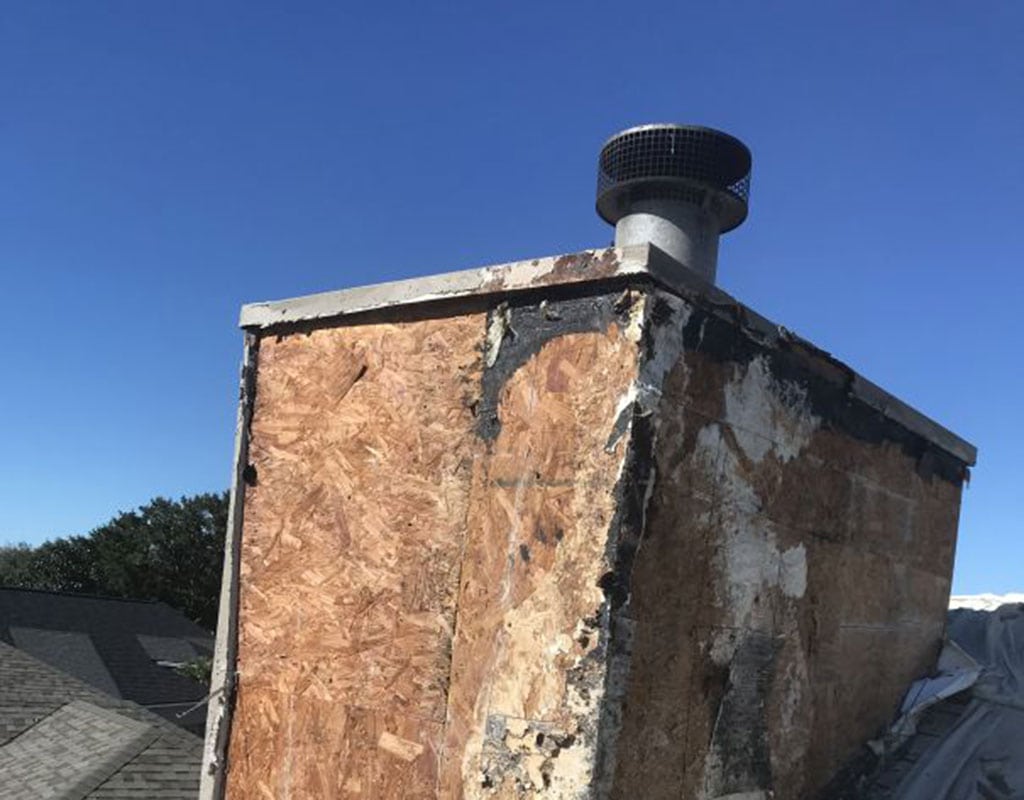
The more serious scenario is when moisture has already gotten behind the foam board. This kind of damage doesn’t announce itself. The exterior can look completely normal while the OSB sheathing behind it is rotting and mold is developing inside the wall cavity. By the time you notice soft spots in the wall, or the foam board moves when you press on it, the damage is typically already significant.
Repair costs for this kind of hidden moisture damage can range from $15,000 to well over $100,000 depending on how far it’s spread — and many insurance policies specifically exclude EIFS moisture damage, which means it often comes entirely out of pocket. That’s why a thorough on-site inspection matters before any work begins.
We don’t quote EIFS repairs from a description or a photo. We need to see the wall, understand the drainage situation, and in some cases probe for moisture before we can give you an honest picture of what you’re dealing with. For situations where the damage has reached the structural level — framing, sheathing, or anything load-bearing — we coordinate with engineers to make sure the repair is done right, not just patched over.
EIFS Repair in Orange County: What Makes Florida Different
The climate context here isn’t just background information — it directly affects how EIFS fails and how repairs need to be approached. Central Florida’s average humidity sits around 74%, and the rainy season runs from June through September, delivering the bulk of that 50-plus inches of annual rainfall in a concentrated stretch. That sustained wet period is what accelerates moisture intrusion behind older barrier EIFS systems. It’s not a single storm event that causes the damage — it’s month after month of high humidity and rain cycling against a wall system that has no way to drain.
For homeowners in 1990s-era communities throughout Orange County, this is a real and present concern. The barrier EIFS installed on those homes was designed for a different set of assumptions about moisture management. It’s now at an age where the sealants at window frames, doorbells, light fixtures, and other penetrations have often degraded — and those joints are where most moisture entry happens. A hairline gap in the caulk around a window frame is all it takes. In Florida’s rainy season, that gap gets tested every day for months.
We’ve been working on EIFS systems in Central Florida for over 20 years, and we’ve seen exactly how this plays out. The homes that hold up are the ones where the penetration sealing has been maintained and the drainage path — if there is one — is clear. The homes that develop serious problems are usually the ones where a surface repair was done without addressing the joint, or where the original installation skipped proper flashing at the base of the system.
When we do EIFS repair work, texture and color matching is part of the job — we work with cosmetic masonry specialists so the repair blends with the existing finish rather than standing out as an obvious patch. The goal is a wall that looks right and performs right, not just one that’s technically fixed.
Not Sure What’s on Your Home? Start With a Real Inspection
If you’re living in a home built between the mid-1980s and early 2000s in Orange County, it’s worth knowing what you actually have on your exterior walls. The tap test takes thirty seconds. What you do with that information is where it gets more nuanced.
EIFS isn’t inherently a problem — modern systems installed correctly perform well even in Orange County’s climate. The issue is older barrier systems that are now aging past their original design life, combined with sealant joints that haven’t been maintained. If that describes your home, the earlier you get eyes on it, the better your options are.
We work with homeowners throughout Orange County on exactly this kind of situation — from initial identification through repair or full restoration, with honest assessments and upfront estimates before any work begins. Reach out and we’ll take a look.