
If you’ve noticed more homes in your neighborhood looking sharper lately — cleaner lines, smoother finishes, warmer tones — you’re not imagining it. Stucco installation across Central Florida is having a genuine moment, and it’s not just about aesthetics. Homeowners from Winter Park to Viera are realizing that the right stucco system does two things at once: it modernizes a home’s exterior and protects it from the kind of moisture and heat damage that Florida dishes out year-round.
The catch is that a great-looking stucco finish and a durable one aren’t automatically the same thing. That gap is exactly what this post is about.
What’s Trending in Stucco Finishes Across Central Florida in 2025
The heavy, rough-textured stucco finishes that dominated Florida construction through the 1990s and 2000s are giving way to something cleaner. Smooth, minimalist stucco is the clear frontrunner in 2025 — and it’s showing up everywhere from Lake Nona’s newer medical city developments to the renovated bungalows along Seminole County’s older corridors.
Color trends are shifting too. The cool grays that ruled the last decade are being replaced by warm neutrals — creamy whites, soft beiges, earthy terracottas, and sunbaked clay tones that feel more grounded and less clinical. Mixed materials are also having a moment: stucco combined with fiber cement panels, warm wood-inspired accents, or subtle stone features. It’s a look that feels intentional rather than builder-grade.
Why Smooth Stucco Finishes Are a Smart Choice for Central Florida’s Climate
Here’s something worth knowing before you fall in love with a finish purely for how it looks: in Florida’s climate, smooth stucco happens to be one of the most practical choices available. That’s not always the case when design trends and durability align — but this time, they do.
Heavily textured stucco finishes have more surface area, more crevices, and more places for moisture to sit and work its way in. Central Florida averages 50 to 60 inches of rain annually, with intense afternoon storms running June through September. When you add in the humidity — which regularly pushes past 80% in summer — those textured surfaces become a maintenance liability over time.
Smooth finishes are easier to seal, easier to inspect, and easier to waterproof properly. That said, the finish itself is only part of the equation. What happens behind the surface matters far more.
About 60% of the stucco failures we see in Central Florida come from water intrusion — not because stucco failed as a material, but because someone skipped the moisture barrier, didn’t install proper flashing around windows, or ignored drainage requirements during installation. The finish you choose affects how the exterior looks and how easy it is to maintain. The installation underneath determines whether any of that matters five years from now.
For homeowners in Volusia County and Brevard County especially, this isn’t an abstract concern. Coastal salt air along the Daytona Beach and Space Coast corridors accelerates stucco degradation faster than inland areas. A smooth finish with proper waterproofing and sealing isn’t a luxury on those properties — it’s the baseline for anything that’s going to last.
Traditional Hardcoat Stucco vs. Modern EIFS: Which Works Best in Central Florida?
This question comes up constantly, and the honest answer is: it depends on the home, the location, and what you’re trying to accomplish.
Traditional three-coat hardcoat stucco — scratch coat, brown coat, finish coat — is the system most Florida homes were built with. When it’s installed correctly over a proper moisture barrier with the right lath and flashing, it’s a proven, durable system. The problem is that “installed correctly” is doing a lot of heavy lifting in that sentence.
Many of the 1990s and early 2000s homes across Orange, Seminole, and Osceola Counties were built during a construction boom when speed often won out over process. That stucco is now 20 to 30 years old and hitting the point where hairline cracks and staining are no longer cosmetic — they’re early warnings.
Synthetic stucco, or EIFS (Exterior Insulation and Finish System), gets a bad reputation that it mostly doesn’t deserve anymore. The early EIFS systems installed in the 1990s lacked drainage planes, and those failures were real and well-documented. Modern EIFS is a different product.
When properly installed with a drainage plane, it outperforms traditional stucco in several important ways: it’s more flexible, which means it handles Florida’s thermal expansion and contraction better without cracking; it insulates the wall assembly, which can reduce energy waste by 18 to 25% in a state where air conditioning runs nearly year-round; and it manages moisture more actively than a hardcoat system.
For homeowners in Celebration in Osceola County — where the entire community’s architecture is built around a specific Mediterranean stucco aesthetic — the choice often comes down to matching what’s already there while upgrading the system underneath. For a newer build in Clermont or a modern renovation in Lake Nona, EIFS with a smooth finish might be the better long-term investment.
The right answer starts with understanding what’s on the wall now, what the local exposure looks like, and what you want the home to do over the next two decades.
What We See Going Wrong With Stucco Installation in Central Florida
Getting multiple quotes for stucco installation is smart. Understanding what’s actually in those quotes is where most homeowners get tripped up. Two quotes that look similar on paper can represent completely different scopes of work — and the difference usually lives in the steps that don’t show up on the surface.
The moisture barrier is the most commonly skipped step in low-quality stucco installations. It’s invisible once the job is done, which makes it easy to omit without the homeowner ever knowing. So is proper window flashing. So are control joints, which manage the expansion and contraction that Florida’s temperature swings cause.
When those steps are skipped, the stucco may look fine for a year or two. Then the cracks start. We’ve spent years undoing this exact scenario across Orange County, Lake County, and Brevard County — pulling out failed stucco systems and rebuilding them the right way.
How to Spot Water Damage Hidden Behind Your Stucco
This is one of the most common questions we hear, and it’s a fair one — because the signs aren’t always obvious until the damage is already significant.
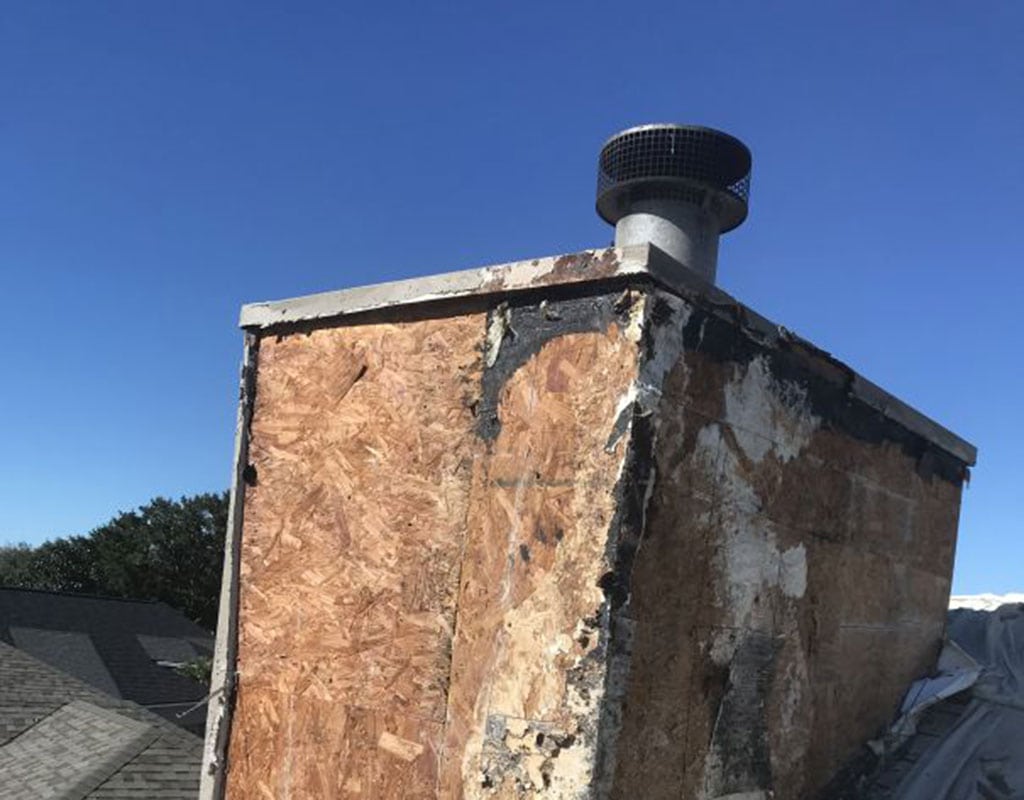
On the surface, early water intrusion often shows up as staining or discoloration, particularly around windows, at the base of walls near grade, or along roof lines. Bubbling or soft spots in the stucco surface are a more serious sign — that’s usually the finish coat separating from the substrate because moisture has compromised the bond. Efflorescence, the white chalky residue that sometimes appears on stucco, is another indicator that water is moving through the wall system.
What makes this harder in Central Florida is the climate. With 50-plus inches of rain per year and humidity that rarely drops below 60%, moisture is always present. A small crack that would be a minor cosmetic issue in a dry climate becomes an active water entry point here.
By the time you see interior signs — water stains on drywall, mold smell, soft spots near windows — the damage behind the stucco has usually been building for months or longer. The most reliable way to know what’s happening behind the wall is a proper inspection by a contractor who actually looks for it, rather than one who just quotes the visible surface.
If you’re in Volusia County or Brevard County and your home is more than 15 years old, a stucco inspection before any cosmetic work is worth the conversation. Painting over a moisture problem doesn’t fix it — it hides it.
Questions to Ask Before Hiring a Stucco Contractor
The single most useful question you can ask any stucco contractor is: what’s included in your moisture management process? If the answer is vague, that tells you something important.
A contractor who knows what they’re doing will be able to explain — in plain terms — how they’re handling the water-resistive barrier, how they’re flashing around windows and doors, and whether control joints are part of the scope. These aren’t bonus features. They’re the steps that determine whether your stucco installation holds up for 20 years or starts showing problems in three.
You should also ask whether the work requires a permit. In Florida, stucco installation — particularly full re-stuccos and new construction — typically requires permits. Unpermitted work can create real headaches when you sell the home, and in some cases it voids your homeowner’s insurance coverage for related damage. A contractor who discourages you from pulling a permit is a contractor worth being cautious about.
Licensing matters too. Florida requires certified specialty contractor licenses for stucco work, and that licensing is verifiable. Ask for the license number and check it. Ask about liability insurance and workers’ compensation coverage — a minimum of $1 million in liability is the standard for quality contractors. We’re fully licensed and insured across Orange, Osceola, Seminole, Volusia, Brevard, and Lake Counties, and we’re happy to provide that documentation before any conversation about scope or cost.
Finally, ask to see examples of texture matching work specifically. If you’re repairing or upgrading a portion of an existing stucco exterior — common in HOA communities in Winter Park, Celebration, or Lake Mary — the ability to match the existing finish is a real skill, not a given. We’ve had homeowners come to us after a previous contractor left a visible patch that looked nothing like the surrounding wall. That’s a problem we take seriously, and it’s one our crews are specifically trained to avoid.
Choosing the Right Stucco Installation for Your Central Florida Home
Modern stucco installation in Central Florida is about more than keeping up with design trends. The smooth finishes and warm palettes transforming homes from Kissimmee to Daytona Beach look great — but they only stay that way when the installation underneath is done to the standard this climate actually demands.
The homes that hold up are the ones where someone paid attention to the moisture barrier, the flashing, the drainage, and the curing time — not just the finish coat. That’s the work that doesn’t show up in photos but shows up every time a storm rolls through.
If you’re thinking about a stucco upgrade, repair, or full installation anywhere in Central Florida, we’re worth a conversation. We cover all six counties, we approach every project with a structural mindset, and we’ll tell you honestly what your home needs — even if it’s not what you were expecting to hear.